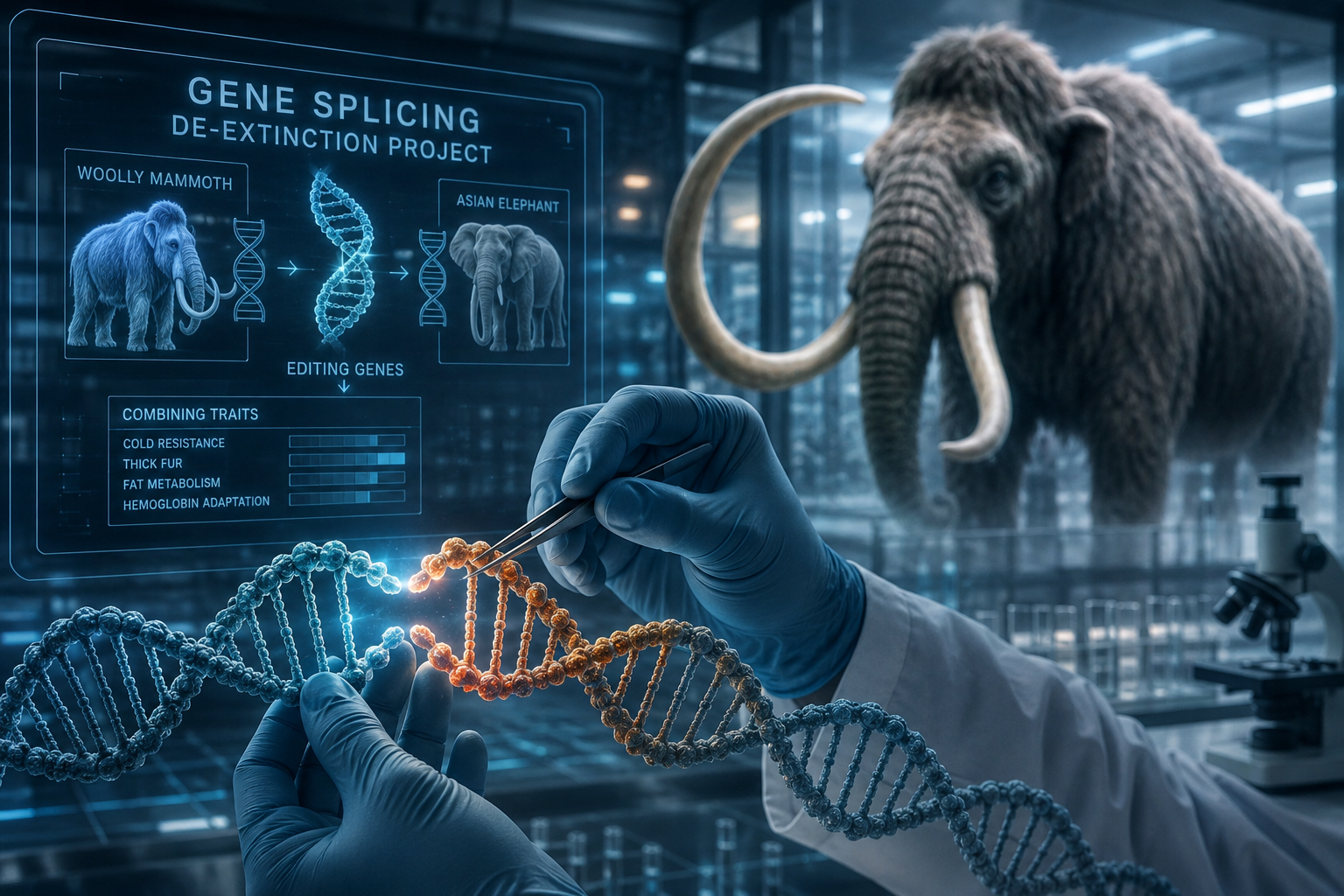
Extinction used to be a permanent system crash. Now, it is just a bug we are patching. Inside the labs of Colossal Biosciences, scientists are treating the woolly mammoth genome not as a fossilized relic, but as an outdated software blueprint waiting for an upgrade. For ten thousand years, the rule of the planet was simple: what dies stays dead. That rule just expired. Armed with CRISPR gene-editing and computational AI, geneticists are actively building a bridge across millennia to pull a multi-ton ice age titan straight into the 21st century. Humanity is moving from passive observers of evolution to its lead authors.
Splicing the Code: How to Build a Giant
The woolly mammoth is no longer a biological memory; it is a software optimization problem. Inside the labs, scientists are bypassing traditional fossilized cloning entirely. Instead, they are executing a masterfully targeted upgrade of the Asian elephant genome—the mammoth's closest living relative, which shares over 99% of its DNA.
The breakthrough is anchored in multiplex CRISPR gene editing, a tool harnessed like a biological command-line interface. Rather than rebuilding all 4.7 billion base pairs from scratch, computational geneticists isolate the hyper-specific code blocks that allowed the mammoth to dominate sub-zero environments:
- The Insulation Profile: Pinpointing the exact genes for thick, shaggy wool hair and dense layers of subcutaneous blubber.
- The Thermal Overclock: Overwriting blood oxygenation traits with prehistoric mammoth hemoglobin to ensure blood pumps flawlessly at minus-50 degrees.
- The Shunted Architecture: Shrinking ear sizes and altering skull shapes to maximize core heat retention.
To pressure-test these genetic edits before deploying them into multi-ton megafauna, researchers have successfully engineered “Colossal woolly mice”—rodents packed with multiple mammoth-like hair and fat mutations.
The raw power of this phase lies in its non-linear execution. By aggressively turning adult elephant cells into induced pluripotent stem cells (iPSCs), scientists can multiply and edit cell lines infinitely in vitro. This means they don't wait for a flawless master file. They edit, test, and adapt the code live, pushing the project past theoretical blueprints and directly toward late-stage IVF execution.
The Tech Stack: Artificial Wombs and AI
Altering the code is only half the battle. The true hardware bottleneck is scaling the manufacturing process. To pull a multi-ton titan out of a digital file, Colossal Biosciences isn't just relying on endangered elephant surrogates; they are building entirely new biological infrastructure. By merging automated artificial intelligence with aggressive mechanical uterine design, the lab is bypassing millions of years of evolutionary constraints in a single generation.
The pipeline begins with massive machine learning deployments. Geneticists generate millions of data points every second—an unmanageable flood of genomic information. Colossal uses its specialized computational biology platform, Form Bio, paired with custom AI modeling teams, to crunch this information. Machine learning neural networks simulate thousands of multiplex edits before a single pipette touches a cell. The AI models and predicts exact computational phenotypes, forecasting precisely how edits to cold-tolerant metabolism or fat distribution will interact across billions of base pairs.
Once the AI validates the genome, the blueprint moves to the mechanical assembly phase. Because the 22-month gestation period of an Asian elephant makes natural breeding an absolute bottleneck, the company is pioneering external gestation machinery. This system acts as a fully scalable, non-biological framework independent of a maternal surrogate:
- The Marsupial Blueprint: Engineers use the fat-tailed dunnart—a small marsupial with a short 13-day timeline—to rapidly prototype their automated artificial uterus.
- The Avian Parallel: The company's scalable engineering approach has already proved successful with its fully artificial egg system, which completely replicates complex natural shell functions to hatch healthy chicks entirely outside a biological mother.
- The Multi-Stage Bridge: For mammals, the team has successfully developed embryos through all three gestational stages in artificial systems. They are actively applying advanced biochemical cues to seamlessly automate the critical transitions between these stages.
This isn’t just a resurrection initiative—it is a launchpad for a sovereign biotech vertical. The sophisticated tools built to manufacture a mammoth are already spinning out highly valued, standalone tech firms like Astromec and Form Bio. By solving the hardest engineering problems in mammalian development, humanity is assembling a commercial tech stack capable of rewriting, incubating, and manufacturing the physical structures of the natural world.
The New Authors of Nature
Bringing back the mammoth proves a definitive point: humanity has graduated from surviving on Earth to actively programming it. This is not a nostalgic effort to reconstruct the past. It is a calculated deployment of a highly engineered living technology designed to forcefully restructure our current biosphere.
The ultimate operational target for these resurrected titans is the Siberian and Arctic tundra. For thousands of years, this land has been a ticking carbon bomb, threatening to release billions of tons of greenhouse gases as the permafrost melts. The engineered mammoth functions as biological heavy artillery designed to neutralize this threat through pure physical scale:
- The Tundra Bulldozer: By trampling down thick, insulating blankets of winter snow, the mammoth's multi-ton weight exposes the underlying soil to extreme arctic air, driving the frost line deeper and locking down the permafrost.
- The Albedo Overclock: Stripping away dark, heat-absorbing brush and replacing it with highly reflective, high-productivity grasslands dramatically increases the landscape's ability to bounce solar radiation back into space.
By achieving this, the project shatters the old, passive framework of conservation. We are no longer limited to merely protecting what is left of a damaged planet. Instead, we are entering the era of planetary terraforming—using synthetic biology to actively manufacture and scale ecological solutions.
The successful deployment of the mammoth will serve as the ultimate proof of concept for global rewilding. It signals the birth of a reality where humanity possesses the absolute technical mastery to dictate the climate, the landscape, and the very trajectory of evolution itself.